

This text was co-written by Safira Rocha and Sara Paulo.
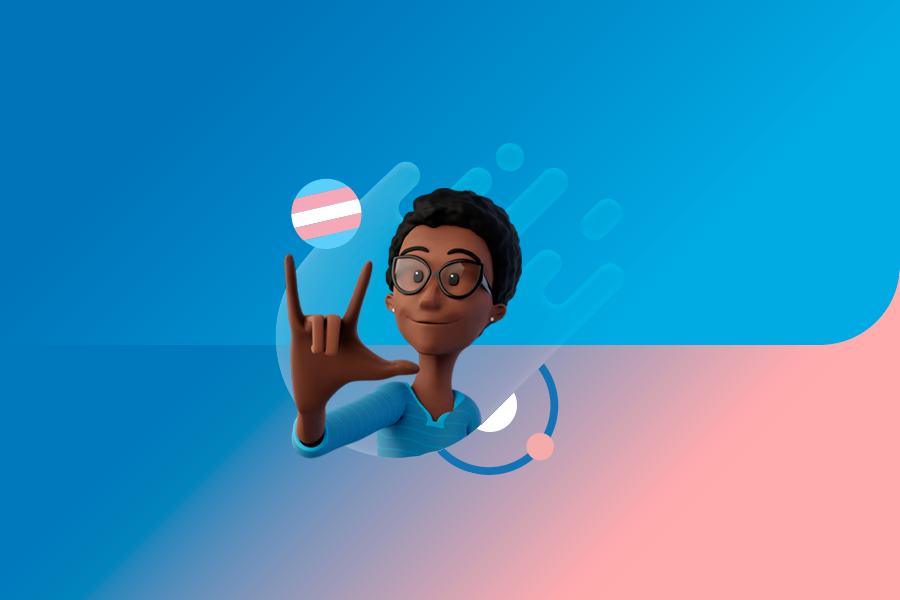
Founded by activist Rachel Crandall (USA) in 2009, the International Transgender Day of Visibility is celebrated annually on March 31st to commemorate the struggle and resistance of the trans community worldwide.
On this important date, we at Hand Talk want not only to give visibility and bring relevant data and information about the cause, but also to share the perspective of Safira Rocha, who is a HandTalker. Read the full article!
What is the importance of Transgender Day of Visibility?
The International Transgender Day of Visibility is not just a celebration of the community’s rights, but also an opportunity to highlight the existence, survival, and, above all, the resistance of the trans community.Safira explains:
“It is important to understand that the trans and transvestite community is denied basic access. Leisure, presence in places, and even the possibility of existing are taken from us, which puts us in places of social exclusion and vulnerability. We want to have the possibility of choice, just as any cis person has”.
And in the international sphere?
Let’s see what some global organizations say about transsexuality:
- The WHO (World Health Organization) officially recognized, in 2018, the understanding that being trans is not a disease and does not require medical, psychological, or religious treatments.
- The UN (United Nations), has the purpose of “promoting and encouraging respect for human rights and fundamental freedoms for all people,” and among its guidelines is the elimination of discrimination against trans people.
No global data on the trans community was found, which goes against the scarcity of care mentioned by Safira.
Responsibility of cisgender people
Cisgender people — that is, those who identify with the gender assigned at birth — occupy most decision-making positions, both at the societal and work levels.
Therefore, Safira calls attention to the responsibility of cis people, inviting them to question themselves: “Why don’t I have trans colleagues?”; “Why don’t companies have trans leaders?”.
“We [trans people] are creative, proactive, autonomous, we have to reinvent ourselves constantly to survive. We have experience, resilience, and adaptability that cis people would hardly understand”.
These qualities, increasingly valued by inclusive leadership, are essential for organizations that seek to be more diverse, accessible, and achieve better results. After all, if we only have people who are the same, the exchanges are not as rich and lack different perspectives!
Access to education can be a start, but inclusion needs to come along
This responsibility can be noted daily if we compare, for example, training of cis people and trans people:
“I know several trans people with many qualifications, but who face barriers to entering the job market due to discrimination. Meanwhile, many cis people occupy positions without so many skills. How qualified do we need to be for a job? What more do you want from us?”.
Safira makes it clear that education is essential for the trans community, but education alone is not enough – along with it, it is necessary to have opportunity and inclusion.
“Beyond schooling or graduation, we fight for a common good: the opportunity to work with dignity and respect, in the area we most identify with”.
Actions for the inclusion of trans people in companies
Beyond just hiring trans people through affirmative action or open positions, Safira Rocha points out some possible initiatives for diverse institutions, including:
- Creating committees focused on discussing the trans cause;
- Carrying out actions and initiatives, such as content, internal communication dynamics, training, and the like;
- Inviting trans people from outside the company to give lectures and lead projects. These can be about trans visibility, but also cover other specialties, such as sustainability, employability, ESG, and other topics.
- In addition to including trans people in the operation, having trans leaders is essential to offer real protagonism and a strategic vision that only a trans person would have!

After all, what are the struggles of the trans cause?
In addition to the points addressed in this text (career, education, international visibility), other issues such as social class, mental health, and gender awareness should also be considered.
Here at Hand Talk, we believe that inclusion is the key to a more diverse future for everyone – that’s why we offer digital accessibility solutions so that as many people as possible can enjoy the web in the best way. Want to make your site more accessible? Talk to specialists by clicking here.
And going back to the question, perhaps the main struggles are:
“The possibility of making choices, remaining in different social scenarios, choosing where and what to work with, having options to grow and achieve success, just like any cis person has.”
Given the data presented, what initiatives can you and your organization implement starting today?
This article was translated by artificial intelligence and reviewed by humans.