

This article was translated by artificial intelligence and reviewed by humans.
Learning another language can be a challenge. But what if this process was as engaging as a game, with points, achievements, and rewards?
That’s exactly what gamification brings to the table. It turns content into something playful, dynamic, and motivating – and now, this proposal is available in our Super App!
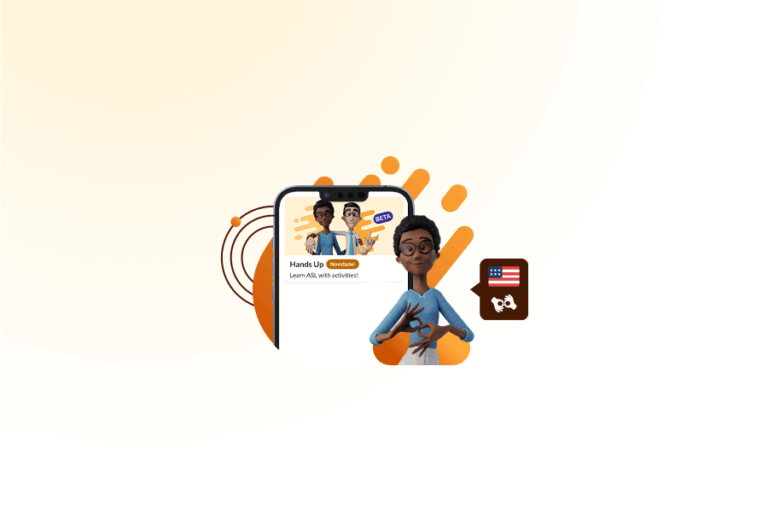
The Hands Up Learning Journey offers a gamified experience in Libras (Brazilian Sign Language) and ASL (American Sign Language), full of challenges and game elements.
To mark this launch, in this article, we will discuss how gamification can enhance Sign Language learning.
But first, what is gamification?
Gamification, according to Wikipedia, is the “‘process of modifying systems, services, organizations, and activities by integrating game elements and design principles into non-game contexts'”.
In other words, we can define gamification as the insertion of playful elements and playful resources into activities not necessarily related to games. But what would these elements be?
Elements of gamification
With the aim of increasing user engagement, motivation, competition, and participation, gamification uses resources inspired by the world of games, such as:
- Points;
- Badges;
- Characters;
- Stories;
among others.
This is the case with Hands Up! In it, you can become a Sign Sage:
🕹️ Earn Experience Points (XP) with each mission, level assessment, and module 🆙
🕹️ Gain Achievements with each module – start with the Awakening of Hands and evolve to Sign Sage 🤟
🕹️ Track all your progress in the account
🕹️ Celebrate your victories with the world: share module completion posts 🚀
These gameplay elements can be added in the two main types of gamification: analog (applied in physical contexts like boards, dice trails, and cards) and digital. And there are diverse possibilities for application!
» Read also: 8 movies about deaf culture and people you need to watch
Application of gamification
Gamification can be present in different contexts, among them, the most common are:
Health
Healthcare professionals, especially those who serve children and young (psychologists, speech therapists, or occupational therapists, for example), use play as a bonding resource in patient treatment.
Marketing
In interactive campaigns, gamification attracts the audience and strengthens brands.
Education
As a pedagogical approach, gamification is used as an active methodology and learning strategy. Education professionals apply it in school activities in physical or digital classrooms.
Digital solutions
As is the case with the Hand Talk App, which combines gamification and fun with the learning methodology of Sign Languages.
» Learn more: Hand Talk App launches Hands Up: Learning Sign Language can be fun and easy
Benefits of gamification in learning Libras and ASL
Incorporating game mechanics into learning makes studying more effective and full of gains:
- Interactive learning: signs are transmitted by virtual translators Hugo and Maya;
- Constant practice: you train naturally and spontaneously;
- Immersion: experience daily situations with Hugo and Maya;
- Progressive evolution: the system of levels and gradual challenges respects your pace;
- Sharing: celebrate each achievement by sharing module completion posts.
Hugo and Maya are ready for this journey. Are you coming?
With Hands Up, learning Libras and ASL transforms into an adventure. The more you learn, the more you gain — and the clearer it becomes how much you have evolved.
To keep you focused, there are short missions at your own pace.
To keep you motivated, Experience Points (XP), Achievements, and moments to celebrate your progress with the world.
Download the Hand Talk App now and start your gamified journey in learning Sign Languages.
nd Talk App e comece sua jornada gamificada no aprendizado das Línguas de Sinais.