
This article was translated by artificial intelligence and reviewed by humans.
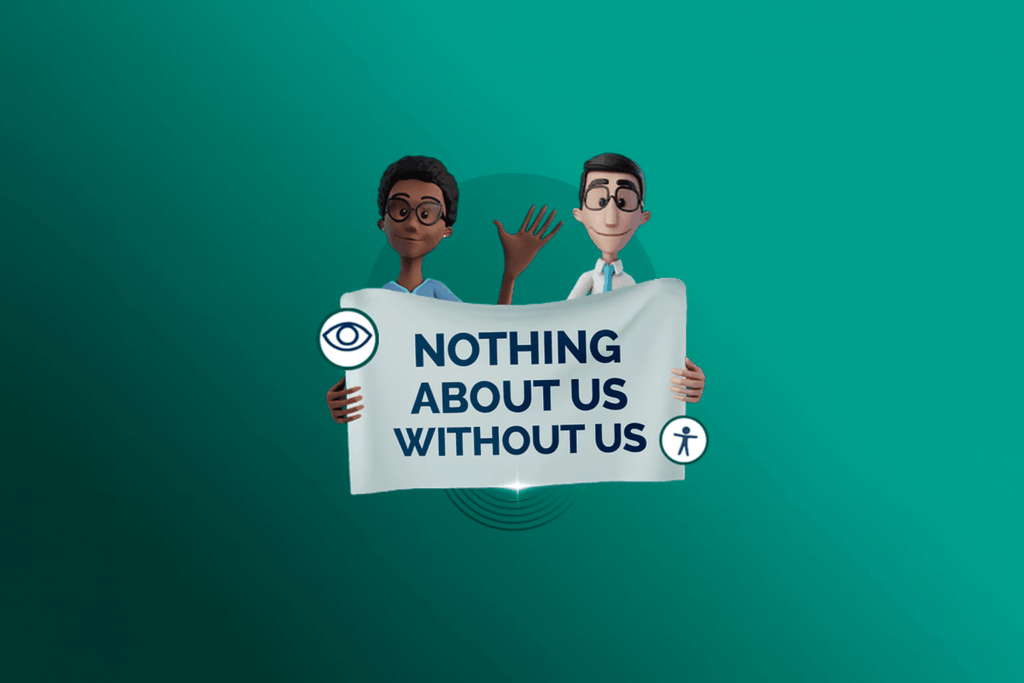
“Nothing About Us Without Us”: if you work with inclusion, seek inspiration, or research technologies to make your company more accessible, you have certainly come across this small phrase, but one full of meaning!
It appears on social media, in presentations, and is used with great pride by people with disabilities.
But what is the real meaning? Why is it so important? Where does it come from? In this article, we at Hand Talk will address this concept and how to apply it effectively in the corporate environment. Join us!
Origin of the motto “Nothing About Us Without Us”
This phrase and its variations have already been applied in different political contexts (such as in 16th-century Poland and 20th-century Czechoslovakia); but the current meaning, linked to the rights of people with disabilities, gained strength in the 1990s in activist circles, conferences, lectures, and books.
And it was the United Nations (UN) that made it better known by choosing the phrase (in its original English, “Nothing About Us Without Us”), to celebrate the International Day of Persons with Disabilities, in 2004.
Over time, the phrase consolidated itself as the, albeit unofficial, motto of autonomy and protagonism of people with disabilities – and we will understand why now!
What does “Nothing About Us Without Us” mean?
Nothing: No thing
About: Relationship between the parts
Us: In this context, people with disabilities
Without: Absence.
In a simple way, the motto reinforces that no decision about people with disabilities should be decided without their full and direct participation.
This includes public policies, products, services, internal processes, communication, technology, and any topic that involves their experiences.
In other words: real inclusion truly happens when people with disabilities participate in discussions from conception to implementation.
“Nothing About Us Without Us” in different contexts and segments
“Nothing About Us Without Us” in the legal field
As with other social groups, laws are implemented by people who do not use them, hence the importance of political representatives with disabilities.
It is essential that people with disabilities occupy not only operational roles, but also management positions, compliance, governance, organizational culture, and more.
“Nothing About Us Without Us” in marketing and communication
As we have seen, representation plays an essential role in making concrete inclusive decisions.
When developing communication and marketing actions, it is fundamental to ensure the inclusion of people with disabilities in all stages: from creation to strategy.
Include them in advertising pieces, seeking actors and models who, in fact, have a disability (be careful with cripface)!
And remember: a good campaign is designed for everyone: add alternative texts, audio description, Sign Language and subtitles.
“Nothing About Us Without Us” in technology and digital
The world is increasingly connected. Having a digital presence is no longer a differential and has become essential.
However, when your website is not digitally accessible, it is as if it were offline for millions of people. The Digital Accessibility Panorama reveals that only 39% of people with disabilities believe that websites meet their navigation needs.
Is your digital environment accessible to them?
How your website can strengthen the motto “Nothing About Us Without Us”
People with disabilities are agents of change and deserve to have their protagonism and visibility respected – after all, they are also present in the digital environment and need to feel increasingly included in this universe.
If your company wants to have a strong digital presence, it is important that its website is accessible, tested, used, and approved by them!